
If you’re tired of paying to heat, clean and repair a pool you rarely use, you have two main ways to get rid of it: full removal or partial removal (often called a “fill-in” or “abandonment”). Both are common in the Phoenix area, and both need a permit. The right choice depends on what you want to do with that part of the yard later, how long you plan to own the house, and your budget.
This guide walks through how each method works, what Arizona permit offices typically require, how long the work takes, and what moves the price. Pool removal is the most common job we do at Arizona Demolition Experts, so these are the same questions we walk through with homeowners on site visits.
Full vs. partial pool removal at a glance
| Partial removal (fill-in) | Full removal | |
|---|---|---|
| What stays in the ground | Pool floor and lower walls, with drain holes cut in the bottom | Nothing. The shell, steel and plumbing come out |
| Typical future use of the area | Lawn, gravel, garden, landscaping | Anything, including additions, ADUs, garages, patios (with engineered compaction) |
| Debris hauled away | Less, since some broken material can stay in the cavity where allowed | All of it |
| Relative cost | Lower | Higher |
| Building over it later | Restricted. Many jurisdictions don’t allow structures over or near an abandoned pool | Allowed with a compaction report |
| Resale questions | Buyers and inspectors may ask about it. Keep permits and final inspection records | Fewer questions, still keep records |
How partial pool removal works
Partial removal means breaking out the top of the pool walls, punching holes through the floor so water can drain, and filling the cavity. As a concrete example of what an Arizona building department expects, Maricopa County’s pool and spa demolition directive (DD-5015-01) for unincorporated areas requires, for a partial removal:
- A demolition permit, with a site plan showing the pool location and its distance to property lines and buildings
- Removing the top of the pool wall to at least 18 inches below grade
- Removing all pool equipment, capping all drains, and removing electrical back to the main service panel
- Cutting two holes in the pool bottom (one at the deep end, one at the shallow end), each at least 2 feet by 2 feet
- An inspection before the pool is filled, to verify the holes, capped plumbing and removed electrical
The same directive allows broken pool wall debris to go back into the pool on a partial removal. It also says that if a building or structure is planned over or within 5 feet of the pool, the cavity must be backfilled under a geotechnical engineer’s supervision to at least 90% relative compaction, with a compaction report approved before final.
Every city sets its own details. Phoenix, Scottsdale, Mesa, Chandler, Gilbert, Glendale and the other Valley cities each run their own permit counters, so the hole size, depth of wall removal and fill rules can differ. Your contractor should pull the permit for the city your property is actually in.
When partial removal makes sense
- You plan to landscape the area or put in grass, pavers on sand, or gravel
- You don’t expect to build an addition, casita, garage or pool house in that spot
- Budget matters more than maximum flexibility
How full pool removal works
Full removal takes everything out: the shell, decking that’s part of the scope, rebar, and plumbing. The hole is then backfilled with clean fill in lifts and compacted. Under Maricopa County’s directive, a full removal where a structure is planned over or within 5 feet of the pool requires removing the entire pool and its utilities, an inspection, and backfill supervised by a qualified geotechnical engineer to at least 90% relative density, with a compaction report approved before final.
When full removal makes sense
- You want the option to build in that area later
- You’re preparing a lot for a teardown and rebuild (see our house demolition service)
- You want the simplest story for future buyers and inspectors
Permits: what Phoenix requires
The City of Phoenix requires a demolition permit for “total, partial or interior demolition of a structure,” and work may not start until the permit is issued, according to the city’s Demolition Permit handout. The same handout notes:
- A Phoenix demolition permit expires if the work isn’t finished within 60 days of issuance, including clearing debris from the site
- When the work is done, you schedule the final inspection through the city’s inspection request system
Phoenix’s fee schedule (City Code Appendix A.2, Part 18) lists the demolition permit fee for a single-family residential structure, including single-family accessory buildings, at $75. Check the current schedule before you budget, since fees change.
If your home is in an HOA, check the CC&Rs too. Some associations want to review backyard changes, gate access or equipment staging before work starts.
Step-by-step: what happens on a typical pool removal
- Site visit and written scope. We look at access (gate width, side-yard clearance, block walls), the pool’s size and construction, decking, equipment, and where trucks can park.
- Permit. The permit is pulled for your jurisdiction. ADE’s written estimate states whether permits are included.
- Utilities and locates. Pool electrical is disconnected and made safe. Before any digging, Arizona law requires contacting Arizona 811 at least two full working days ahead so underground utilities can be marked (A.R.S. 40-360.22; Arizona 811 homeowner page).
- Drain the pool. The water is pumped out. Ask your city about where pool water may be discharged.
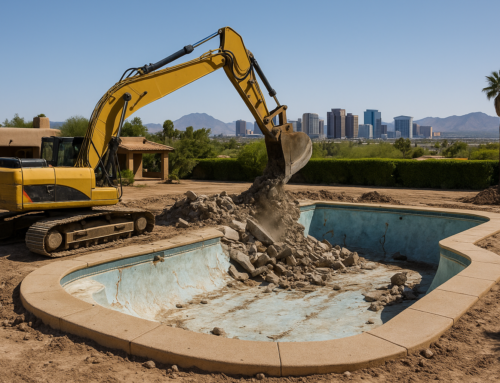
- Demolition. Coping, tile and walls are broken out. For a partial, the floor is perforated; for a full, the whole shell is removed and hauled.
- Pre-fill inspection where the jurisdiction requires it.
- Backfill and compaction. Fill goes in lifts and is compacted. Engineered compaction and testing are added when you plan to build over the area.
- Grading and final inspection. The area is graded and the permit is closed out.
How long does pool removal take?
The on-site work for many residential pools is measured in days, not weeks, but the full timeline also includes the permit, utility locates (two working days minimum for Arizona 811), any inspection waits, and compaction testing if you need it. Full removals take longer than partials because there’s more to break and haul. Tight access, caliche and summer heat can also slow the work. Ask any contractor for a written schedule with these steps listed separately.
What affects pool removal cost in the Phoenix area
We don’t publish flat prices because two pools the same size can cost very different amounts. For a national reference point, HomeGuide’s cost guide lists inground pool demolition at about $4,000 to $16,000 and above-ground pool removal at about $300 to $2,500. Treat those as typical national ranges, not Arizona quotes. The things that move your number:
- Full vs. partial. Full removal hauls far more material and usually needs more fill and compaction.
- Access. A narrow side gate or a block wall in the way means smaller equipment, more hand work, or taking down and rebuilding a wall section.
- Caliche. Much of the Valley has a cemented calcium carbonate layer that’s slow to break. It mainly affects full removals and any excavation below the shell.
- Pool construction and size. Gunite and shotcrete shells with heavy rebar take longer than vinyl or fiberglass.
- Decking and extras. Concrete deck, spa, rock waterfalls and equipment pads add demolition and hauling.
- Fill and compaction. Engineered compaction with testing costs more than standard landscape fill.
- Disposal distance. Concrete is heavy, and haul time to a recycler or landfill adds up.
To get an actual number for your yard, request a pool removal estimate and we’ll come out, measure and give you a written scope.
Will removing a pool hurt resale?
It depends on your buyers. Some Phoenix buyers want a pool; others see it as a maintenance cost. What matters most for resale is that the work was permitted and passed final inspection. Keep the permit, inspection sign-off and any compaction report with your house records. If you did a partial removal, expect buyers or their inspectors to ask about it.
Frequently asked questions
Do I need a permit to remove a pool in Phoenix?
Yes. Phoenix requires a demolition permit for total or partial demolition of a structure, and work can’t start until the permit is issued. Other Valley cities and unincorporated Maricopa County have their own permit requirements.
Can I build over a partially removed pool?
Usually not without extra steps. Maricopa County’s directive, for example, requires engineered backfill and a compaction report if a structure is planned over or within 5 feet of the pool, and it doesn’t allow new structures over a pool that was abandoned in place. If you might build there, plan for a full removal or engineered compaction.
Is a fill-in the same as a partial removal?
People use the terms loosely. In most permit language, a partial removal breaks the top of the walls below grade and perforates the floor before filling. Some jurisdictions also recognize “abandon in place,” which leaves more of the shell. Ask which method your contractor is proposing and how the permit describes it.
Do I need to call 811 before pool removal?
Yes. Arizona law requires contacting Arizona 811 at least two full working days before digging so utilities can be located and marked.
How long does pool removal take?
On-site work for many residential pools takes days, but the total timeline includes permits, utility locates, inspections and compaction testing. Full removals take longer than partials.
Does Arizona Demolition Experts handle the permit?
Our written estimate spells out whether the permit is included for your job. Ask during the site visit and we’ll explain what your city requires.
Get a written pool removal estimate
Arizona Demolition Experts (ROC# 349951) has handled demolition projects across the Valley since 2020. Call 480-674-8348, email info@arizonademolitionexperts.com, or request an estimate online. Also see pool demolition in Phoenix and our concrete removal service for decks and slabs.


Leave A Comment